For most Arizona small business owners, a lease is the largest financial obligation outside of payroll — yet it’s often signed with less scrutiny than a vendor contract.
Commercial leases are not designed to be “fair.”
They are designed to protect the property owner first.
This guide will walk you through:
- The most common hidden risks in Arizona commercial leases
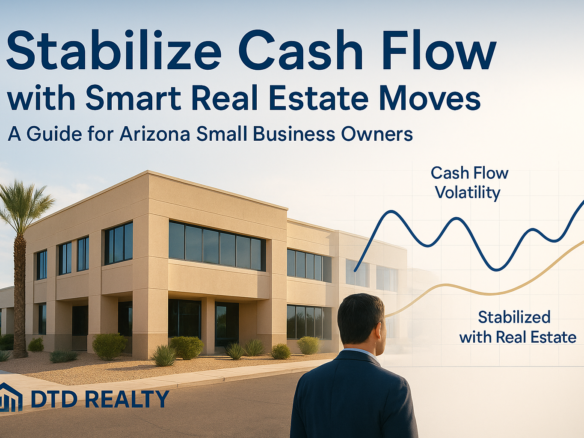
- The financial traps that quietly destroy cash flow
- The negotiation angles most tenants never use
- And how to protect your business before you commit to 3–10 years of rent
Why Commercial Leases Are So Different From Residential Leases
Unlike apartments:
- Commercial leases are heavily negotiable
- State tenant protections are far more limited
- Landlords can shift far more risk onto the tenant
- “Standard forms” heavily favor ownership
This means:
What you sign matters more than where you sign.
Step One: Understand Your Lease Structure (Before You Review Anything Else)
Before you analyze a single clause, you must identify the rent structure, because it determines your true long-term cost.
Most Common Arizona Lease Types
| Lease Type | What It Means for You |
|---|---|
| Gross Lease | Rent is mostly fixed and predictable |
| Modified Gross | Some expenses included, some passed through |
| NNN (Triple Net) | Tenant pays taxes, insurance, and maintenance |
| Absolute NNN | Tenant pays everything, including roof & structure |
Mistake #1: Assuming NNN rent is “cheaper”
NNN is often the most expensive lease structure over time once taxes, insurance, and CAM charges rise.
Hidden Risk #1: Uncapped Operating Expense Pass-Throughs
Many Arizona leases allow:
- Unlimited property tax increases
- Unlimited insurance premium increases
- Unrestricted CAM reconciliation charges
This means your rent may be “fixed,” but your total monthly payment is not.
✅ Negotiation Angle:
- Request expense caps
- Demand CAM audit rights
- Exclude capital improvements from pass-throughs
Hidden Risk #2: Personal Guarantees That Never Burn Off
Many landlords require:
- Full personal guarantees
- Even when your business is an LLC or corporation
This means:
- You remain liable even after selling your business
- You remain liable even after assigning the lease
✅ Negotiation Angle:
- Step-down guarantees after Year 2–3
- Guaranty burn-off after performance benchmarks
- Limited “good guy” guarantees
Hidden Risk #3: Assignment & Subleasing Restrictions
Some Arizona leases:
- Prohibit assignment entirely
- Allow landlord to cancel if you sell your business
- Require excessive consent fees
This traps owners during:
- Business sales
- Partner changes
- Mergers or acquisitions
- Financial distress
✅ Negotiation Angle:
- Pre-approve assignment upon business sale
- Cap consent fees
- Carve out affiliate transfers
Hidden Risk #4: Relocation & Demolition Clauses
Retail and office leases often include:
- Landlord relocation rights
- Early termination for redevelopment
- Forced unit reassignments
This can destroy:
- Customer traffic
- Brand visibility
- Build-out investment
- Signage value
✅ Negotiation Angle:
- Termination penalties paid to you
- Full build-out reimbursement
- Moving cost coverage
- Advance notice minimums
Hidden Risk #5: Silent Use Restrictions
Use clauses can:
- Block future business pivots
- Prohibit product diversification
- Prevent alcohol, medical, or specialty services
- Limit operating hours
Many owners discover this after growth plans are underway.
✅ Negotiation Angle:
- Broad use clauses
- “Any lawful use” language
- Explicit expansion allowances
Hidden Risk #6: Renewal & Rent Reset Traps
If renewals are:
- “At market” with no formula
- Subject solely to landlord discretion
You risk:
- Massive rent resets
- Forced relocation later
- Loss of long-term site control
✅ Negotiation Angle:
- Pre-negotiated renewal increases
- CPI-based caps
- Multiple option periods
Hidden Risk #7: Prohibited Sale Value Destruction
Poorly written leases reduce business resale value by:
- Blocking assignment
- Triggering rent re-pricing on sale
- Voiding options upon ownership change
This can reduce buyer interest and sale price.
✅ Negotiation Angle:
- Lease portability protections
- Sale-safe assignment language
- Continuity guarantees
The Most Common Arizona Lease Negotiation Myths
❌ “This is a standard lease — it can’t be changed.”
✅ Nearly everything is negotiable
❌ “The rent is good, so the lease is good.”
✅ Rent is only one of 15+ financial variables
❌ “NNN just means cheaper base rent.”
✅ NNN transfers massive future risk to tenants
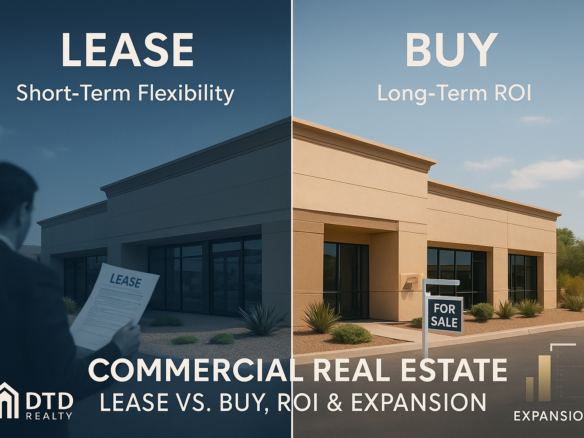
When You Should Strongly Consider Buying Instead of Leasing
You should at least evaluate ownership when:
- Your business is stable
- You plan to stay in one location 7+ years
- SBA financing is available
- Lease control risks are high
- You want long-term occupancy certainty
Many Arizona owners convert:
Rent payments → Equity → Long-term rental income
Your Lease Affects More Than Just Rent
A commercial lease directly impacts:
- Cash flow
- Business valuation
- Exit strategy
- Financing options
- Personal liability
- Asset protection
- Retirement planning
It is not a formality — it is a financial control document.
Final Thought: A Good Location Can’t Save a Bad Lease
Your signage, traffic, and build-out cannot protect you from poor lease language.
The strongest Arizona business owners approach leasing the same way they approach:
- Hiring executives
- Signing franchise agreements
- Buying commercial real estate
With professional review, negotiation strategy, and long-term foresight.
DTD Realty — Do The Deal.
Driven. Trusted. Dependable.
📞 602.702.3601
🌐 https://www.dtdrealty.com
📩 [email protected]