**A Practical Sizing Guide for Arizona Small Business Owners**
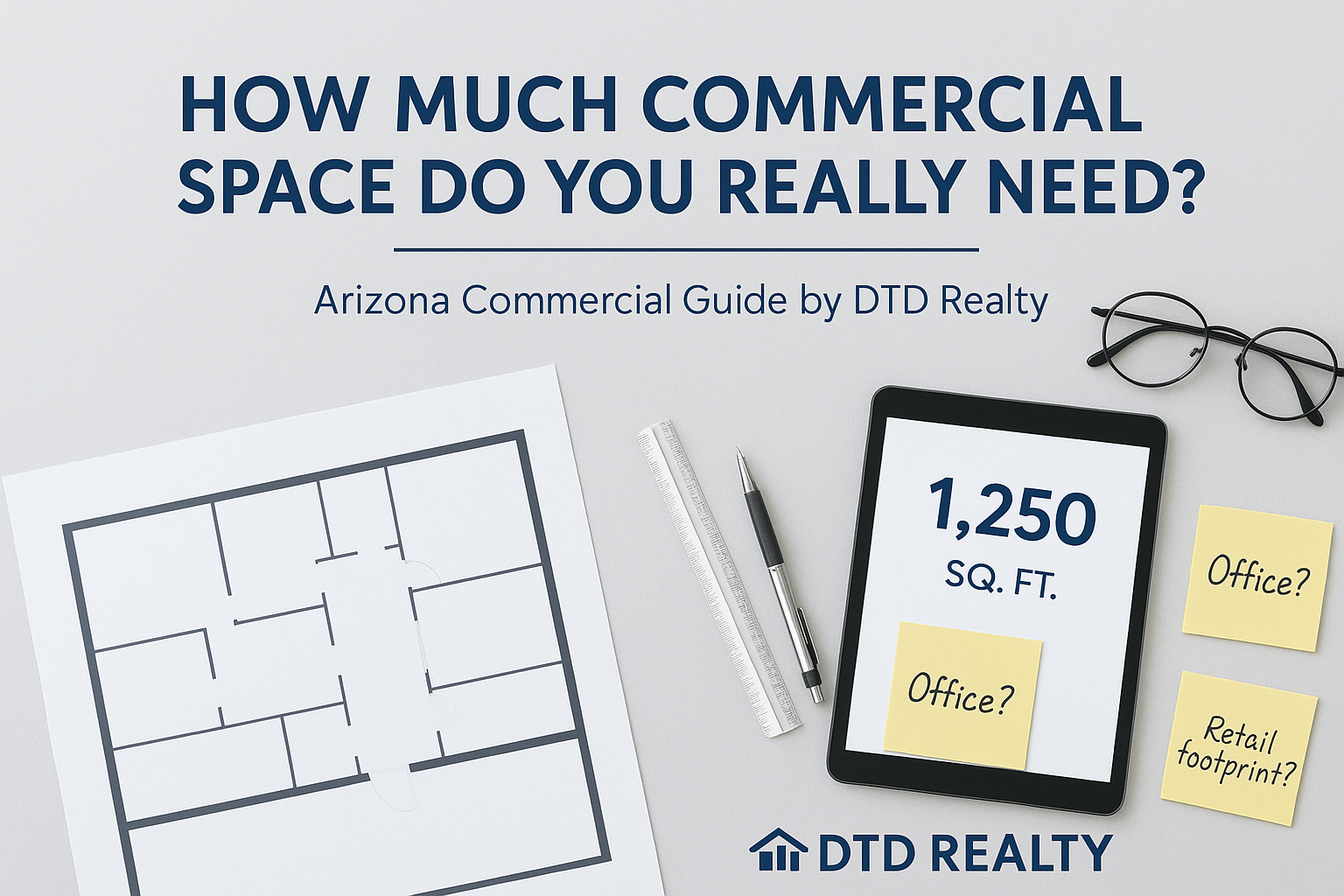
Choosing the right amount of commercial space is one of the most common (and most expensive) decisions Arizona small business owners face. Lease too much, and you’re paying for square footage you don’t actually need. Lease too little, and you’re cramped, inefficient, or forced into an early move—often years before your business is ready.
Whether you’re opening a retail shop along McDowell, launching a new restaurant, expanding your service business into a flex space, or searching for a live/work setup near the Ideal Hubs, this guide gives you a clear, practical framework for getting your space size right from day one.
Start With Your Business Model First (Not the Square Footage)
Many owners start their search by asking, “How many square feet can I afford?”
A better first question is:
“What does my business physically do inside the space?”
Your layout drives your size requirements, not the other way around.
Begin with:
What functions need space?
– Retail floor
– Kitchen or prep area
– Offices
– Storage
– Customer seating
– Staff workstations
– Showroom displays
– Production or repair equipment- What has to be separated due to noise, safety, or workflow?
- What’s your expected customer flow?
Once you map these out, the square footage becomes clear—often smaller or more efficient than you expected.
Industry Benchmarks for Arizona Businesses
Here are realistic sizing guidelines based on common business types in Phoenix, Tempe, Scottsdale, Mesa, and Tucson. These reflect current build-out patterns, Fire Code norms, and market chatter with landlords and architects.
Retail (Boutiques, Specialty Shops, Service Retail)
800–1,500 SF for most startups
1,500–2,500 SF for established operators or destination retail
Layout driver: display space + storage + POS area
Professional Office (Real Estate, Law, Insurance, Counseling)
120–200 SF per private office
60–80 SF per workstation
+200–400 SF for reception, conference, break room
Most small firms land between 800–1,800 SF
Restaurants / Food Concepts
QSR / Fast-casual: 600–1,400 SF front-of-house, 400–1,000 SF back-of-house
Full-service: 2,000–4,000 SF
Ghost kitchen: 300–800 SF
The constraint is always the kitchen layout + code compliance.
Salon / Personal Care
800–1,600 SF
Rule of thumb: 125–150 SF per station + back room + reception.
Light Industrial / Flex / Trades
1,200–2,500 SF for small contractors, makers, and service businesses
3,000–5,000 SF if storing materials or vehicles
Always check: power requirements, bay height, and loading access.
Live/Work Spaces
600–1,200 SF total footprint
Often perfect for creatives, consultants, and solopreneurs.
“Growth Buffer”: How Much Extra Space Should You Build In?
If you expect slow, predictable growth:
Add 10–15% above your day-one needs.
If you expect fast hiring or customer-base growth:
Add 20–25% buffer.
(Especially important in professional offices and retail.)
If your business is equipment-intensive:
Plan for 20–30% because machinery and storage grow faster than you think.
If your business is uncertain or early-stage:
Keep it tight.
It’s safer to outgrow your space than be suffocated by overhead.
Space Efficiency: How to Reduce Square Footage Without Reducing Output
Smart layout can save 100–500 SF—and thousands annually.
A. Multi-use spaces
- Conference room doubles as training space
- Back office doubles as storage
- Workstations instead of private offices
- Rolling storage shelves
B. Smart inventory management
Retailers often save 200–400 SF just by tightening stock levels.
C. Vertical storage
Especially helpful in flex/industrial.
D. Outdoor space utilization
Some Arizona landlords allow outdoor displays, patio seating, or storage corrals.
Hidden Space Requirements Business Owners Forget
These often push tenants 10–20% above their initial estimate:
- Janitor closet & mop sink (required in many occupancies)
- ADA bathroom(s)
- Code-required corridor width
- Office server/IT space
- Employee lockers or break area
- Access to electrical room (landlord-controlled)
- Refrigeration/hot water systems for food concepts
- Extra storage caused by supply chain shifts
A professional space planner or architect can save you expensive surprises.
Arizona-Specific Factors That Affect Your Space Needs
A. Parking Ratios
Some Arizona cities require:
- 4–5 spaces per 1,000 SF for retail
- 6–10 per 1,000 SF for restaurants
- Lower ratios for office/flex
Your parking requirement may limit your square footage even if the interior fits.
B. HVAC Load
Arizona heat affects:
- Layout
- Equipment location
- Kitchen ventilation
- Utility room size
- RTU or mini-split placement
C. TI Allowances
Landlords in Phoenix metro often provide $20–$40/SF in TI for strong tenants.
Planning your size correctly maximizes what your TI dollars can actually finish.
When You Should Not Take More Space — Even if You Can Afford It
Avoid excess square footage if:
- Your concept may pivot
- Your industry is cyclical
- You’re testing a new market
- Your staffing isn’t stable
- Your equipment needs are uncertain
- You’re not confident in year-two revenue
Right-sizing beats over-sizing 100% of the time.
When You Should Take More Space
It’s smart to stretch for extra room if:
- You have strong hiring projections
- Your concept is buildout-intensive (better to build once)
- You plan to use SBA 504/7(a) to buy instead of lease
- You’re confident in your current customer pipeline
- You intend to sublease temporarily to offset cost
Final Takeaway: Your Square Footage Should Serve You — Not Stress You
Choosing commercial space isn’t just a real estate decision—it’s a business strategy decision.
Right-size your space based on:
- what your business actually does
- where you’re going over the next 3–5 years
- your Arizona submarket
- your staffing and customer flow
- code and parking considerations
- your budget and risk tolerance
There is no “perfect amount” of space—only the amount that maximizes your profitability and keeps your overhead manageable.
If you want help estimating the right square footage for your Phoenix-area business, I can model out several scenarios for you based on your layout, expected growth, and preferred submarkets.
DTD Realty — Do The Deal.
Driven. Trusted. Dependable.
📞 602.702.3601
🌐 https://www.dtdrealty.com
📩 [email protected]