Choosing the right commercial lease can make or break a small business—especially in Arizona, where operating costs, property taxes, insurance, and landlord expectations vary widely between submarkets. Whether you’re opening your first brick-and-mortar location or expanding into a second site, understanding the structure of your lease is one of the most important financial decisions you’ll make.
Let’s break down the major differences between NNN leases and Gross leases, explain what each means for your cash flow, and explore how Arizona-specific conditions (like rising insurance and property taxes) affect your decision.
What Is a NNN Lease?
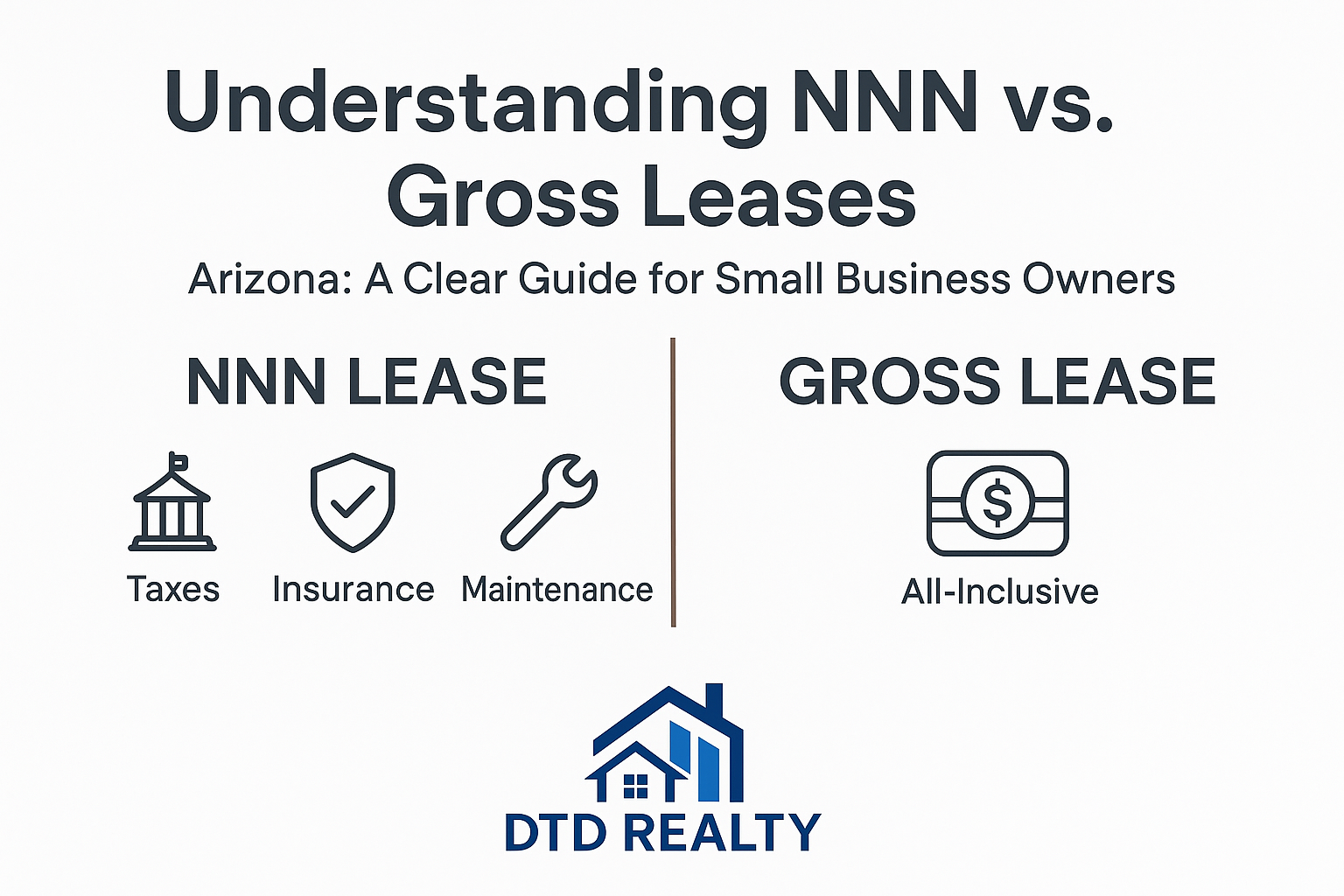
A Triple Net Lease (NNN) is a structure where the tenant pays:
- N – Property taxes
- N – Property insurance
- N – Common Area Maintenance (CAM) or operating expenses
Plus your base rent.
What this means for you:
- Your monthly cost includes base rent + NNN charges, which vary depending on the property.
- You directly feel market shifts—like rising insurance premiums or higher property taxes.
- CAM charges can include parking lot maintenance, landscaping, property management fees, and sometimes capital improvement pass-throughs.
What Arizona tenants should know:
- NNNs are most common in retail, office condos, medical, and newer developments.
- NNN charges in Phoenix have risen steadily because:
- Property insurance premiums increased statewide.
- Municipalities have reassessed property values.
- CAM costs rose due to labor and materials inflation.
- Annual reconciliations can surprise first-time tenants—sometimes with a bill.
Typical use case:
Ideal for prime retail corridors where visibility is high and landlord-maintained facilities benefit your business.
What Is a Gross Lease?
A Gross Lease means the tenant pays one monthly number—base rent that includes most operating expenses.
What this means for you:
- The landlord absorbs most or all of the variable expenses.
- Your rent is more predictable, stable, and easier to budget.
- Gross leases may have annual increases (3–5% is common) built in.
What Arizona tenants should know:
- Gross leases are more common in older office buildings, flex spaces, and some industrial properties.
- Some Gross leases are actually Modified Gross, meaning:
- You might still pay utilities
- You may pay janitorial
- You may share some CAM items
- Always verify what’s truly included—“Gross” is not a universal standard.
Typical use case:
Great for office users, first-time tenants, or businesses prioritizing predictability over control.
NNN vs. Gross Example (Arizona-Specific)
Example: Retail User on McDowell Corridor
You’re evaluating a 1,000 sq ft retail suite.
Option A — NNN Lease
- Base rent: $28/sf/year
- NNN charges: $7.50/sf/year
- Total monthly: $2,937/month
But NNN charges can adjust yearly, and if Maricopa County increases taxes again, your costs rise.
Option B — Gross Lease
- Gross rent: $32/sf/year
- Total monthly: $2,666/month
The Gross lease appears cheaper and more stable, though the building may be older with fewer amenities.
Which Lease Type Is Better for Your Small Business?
Choose a NNN Lease If:
- You want newer construction or prime locations
- You prefer landlord-maintained appearance and facilities
- You can absorb variable costs
- Your business benefits from strong visibility and high traffic
Choose a Gross Lease If:
- You want predictable monthly costs
- You’re in growth mode and prioritizing cash-flow stability
- You prefer simplicity over control
- You’re in office, flex, professional services, or low-footprint use
How to Protect Yourself When Evaluating NNN Charges
Arizona tenants should always:
- Request 3 years of historical CAM reconciliations
- Identify any pending capital improvement projects
- Ask whether major repairs (HVAC, roof, parking lot) are passed through
- Confirm what’s included in management fees
- Get clarity on tax reassessment exposure
A good broker (hi, that’s me 👋) will walk you through line-by-line comparisons so you avoid surprises.
Submarket Considerations (Phoenix Metro)
Certain areas lean heavily toward one lease type:
Mostly NNN
- Downtown Phoenix retail
- Tempe retail near ASU
- Chandler/Gilbert new retail centers
- Scottsdale corridor (Shea, Old Town, and Airpark retail)
Mostly Gross or Modified Gross
- Office buildings in Midtown and Biltmore
- Flex/office in Deer Valley and Chandler Airpark
- Older retail strip centers in West Valley
- Industrial in Tolleson and Laveen (though some are NNN)
Your decision should align with your business’s cash-flow tolerance, growth plans, and location priorities.
Final Thoughts
NNN and Gross leases each carry advantages, and neither is universally “better.” The right choice depends on your business’s risk tolerance, growth stage, and need for predictability. Understanding how each structure affects your costs—especially in Arizona’s rising insurance and tax environment—puts you in a stronger position to negotiate well.
And of course, if you need help sourcing, comparing, or negotiating a lease anywhere in the Phoenix metro, DTD Realty is here to help.
DTD Realty — Do The Deal.
Driven. Trusted. Dependable.
📞 602.702.3601
🌐 https://www.dtdrealty.com
📩 [email protected]