Arizona investors love quick rules of thumb—and for good reason. When you’re screening dozens of potential rental properties, simple benchmarks help you separate “worth a deeper look” from “don’t waste time.”
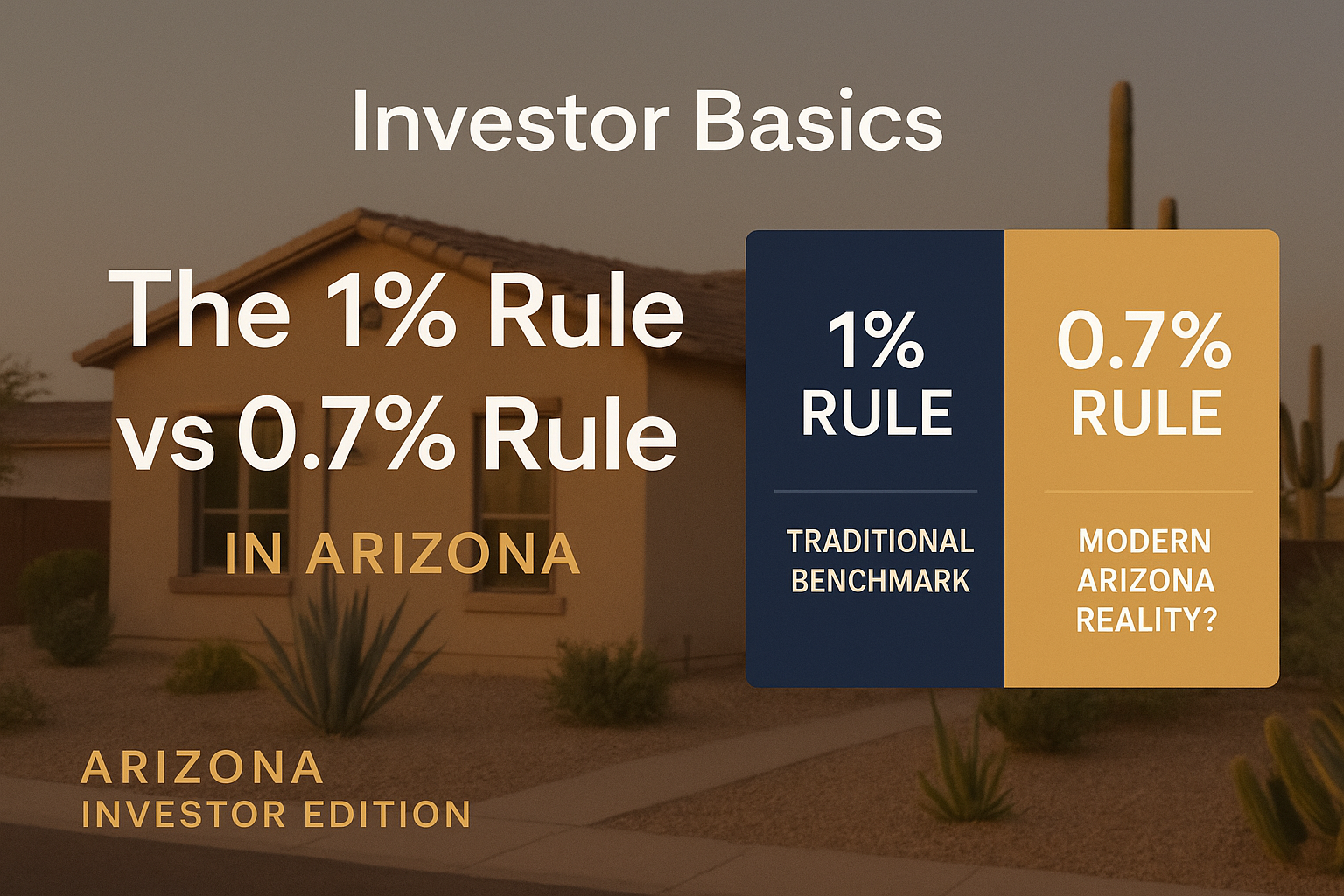
Two of the most popular rules are the 1% Rule and the 0.7% Rule.
But here’s the catch: Arizona’s market is wildly different from the Midwest markets where these rules originally took hold.
So, what do these rules actually mean, and how should you use them today, in places like Phoenix, Mesa, Chandler, Tucson, and the rapidly growing suburban markets?
Let’s break it down, investor-friendly style.
What Is the 1% Rule?
The 1% Rule says:
A rental property’s monthly rent should be at least 1% of the property’s purchase price.
Example:
Purchase price: $350,000
Target rent using the 1% rule: $3,500/mo
If rent is below the 1% threshold, the property may not produce strong cash flow after accounting for realistic expenses.
✔ Why It Became Popular
- Works well in lower-cost, high-cash-flow markets
- Quick filter for cash flow potential
- Helps eliminate overpriced rentals early
✖ The Problem in Arizona
Arizona’s median purchase prices—especially in Maricopa and Pima counties—are too high relative to average rents for most properties to hit 1%.
For example:
- $400,000 Phoenix SFR often rents for $2,200–$2,500
- $500,000 property in Chandler might rent for $2,600–$3,000
- Newer build communities rarely exceed 0.6–0.75%
This doesn’t mean the deal is bad. It means the 1% Rule isn’t realistic in this market—especially for Class A or B properties.
What Is the 0.7% Rule?
The 0.7% Rule is the “Arizona-adjusted” version that many local investors now use.
A rental’s monthly rent should equal at least 0.7% of the purchase price to potentially cash flow in Arizona.
Example:
Purchase price: $350,000
0.7% rent target: $2,450/mo
That is far more achievable across the Valley.
✔ Why It Works Better in Arizona
- Matches real world rent-to-cost ratios
- Aligns with current insurance, taxes, and maintenance levels
- Works especially well for newer homes (2000+)
- Matches typical rents in Phoenix, Mesa, Buckeye, Queen Creek, Surprise, and Tucson
Reality check:
Most good buy-and-hold investors in Phoenix today land between 0.6%–0.75%.
Real Arizona Examples (2025)
To show how this works on the ground, here are realistic snapshots based on what DTD Realty sees daily:
Example A: Phoenix (North) – 1990s SFR
- Price: $425,000
- Rent: $2,550
- Rent ratio: 0.6%
- Likely cash flow? Light
- Strategy fit: Long-term appreciation + tax benefits
Example B: Mesa (Eastmark area) – 2018 build
- Price: $500,000
- Rent: $2,900
- Rent ratio: 0.58%
- Likely cash flow? Minimal
- Strategy fit: Premium tenant base, low capex
Example C: West Valley (Surprise) – 2005 SFR
- Price: $360,000
- Rent: $2,400
- Rent ratio: 0.67%
- Likely cash flow? Solid
- Strategy fit: Best blend of cash flow + growth
Example D: Tucson – 1970s Home (Updated)
- Price: $285,000
- Rent: $1,950
- Rent ratio: 0.68%
- Likely cash flow? Good
- Strategy fit: Cash flow + value-add
How to Use These Rules When Screening Properties
Here’s the simple workflow some of our investor clients use:
Step 1 — Run the rent ratio against 0.7%
If the property falls below 0.6%, it may struggle to cash flow unless:
- You buy below market value
- You add value through renovations
- You use short-term or medium-term rental strategies
- You use a DSCR loan with strong terms
Step 2 — Check rents using real Arizona comps
Use:
- Zillow + Rentometer (directional only)
- Local PMs (the real gold)
- other online investor rent databases
Step 3 — Perform a full NOI + cash-flow analysis
Rules of thumb are filters, not decisions.
You still need to break down:
- gross income
- vacancy
- property taxes
- insurance
- repairs
- capex
- management
- HOA
- utilities (if any)
- financing
Step 4 — Prioritize long-term returns
Even if a property doesn’t hit 0.7%, it might still be a fantastic investment based on:
- equity growth
- tax advantages
- rent growth trend lines
- neighborhood appreciation patterns
Arizona is an appreciation-first market with healthy rent growth, so many strong deals fall short of 1% rules.
So… Which Rule Should Arizona Investors Use?
📌 The 1% Rule is mostly unrealistic here.
It’s great for quick math in low-cost markets, but rarely works in Phoenix or Tucson.
📌 The 0.7% Rule is the Arizona benchmark.
This is the right filter to screen out overpriced properties and identify rentals worth deeper analysis.
📌 The best deals often sit between 0.6%–0.75%.
That’s where most of your long-term performers come from.
Final Thoughts: Use Rules to Filter—Not to Decide
Rules like the 1% Rule and 0.7% Rule help you move efficiently.
But your real decision should be based on:
- NOI
- Cash-on-cash return
- Long-term appreciation
- Your financing terms
- Your goals (cash flow vs wealth building)
If you find a property that:
- hits 0.6%+,
- is in a strong tenant-demand area,
- has predictable expenses, and
- offers solid long-term fundamentals…
…it’s probably worth a deeper look.
If you want help finding those properties—or want me to run a full investment analysis on something you’re looking at—just upload the link and I’ll break it down.
DTD Realty — Do The Deal.
Driven. Trusted. Dependable.
📞 602.702.3601
🌐 https://www.dtdrealty.com
📩 [email protected]