If you use financing to purchase investment property—and most Arizona investors do—then cash-on-cash return (CoC) is one of the most important metrics you’ll ever learn. It tells you how hard your actual invested dollars are working for you each year.
If cap rate is the “big picture,” cash-on-cash is the real-world return on the money you actually put in.
This guide breaks it down in simple terms, with clean examples and Arizona context.
What Is Cash-on-Cash Return? (Simple Definition)
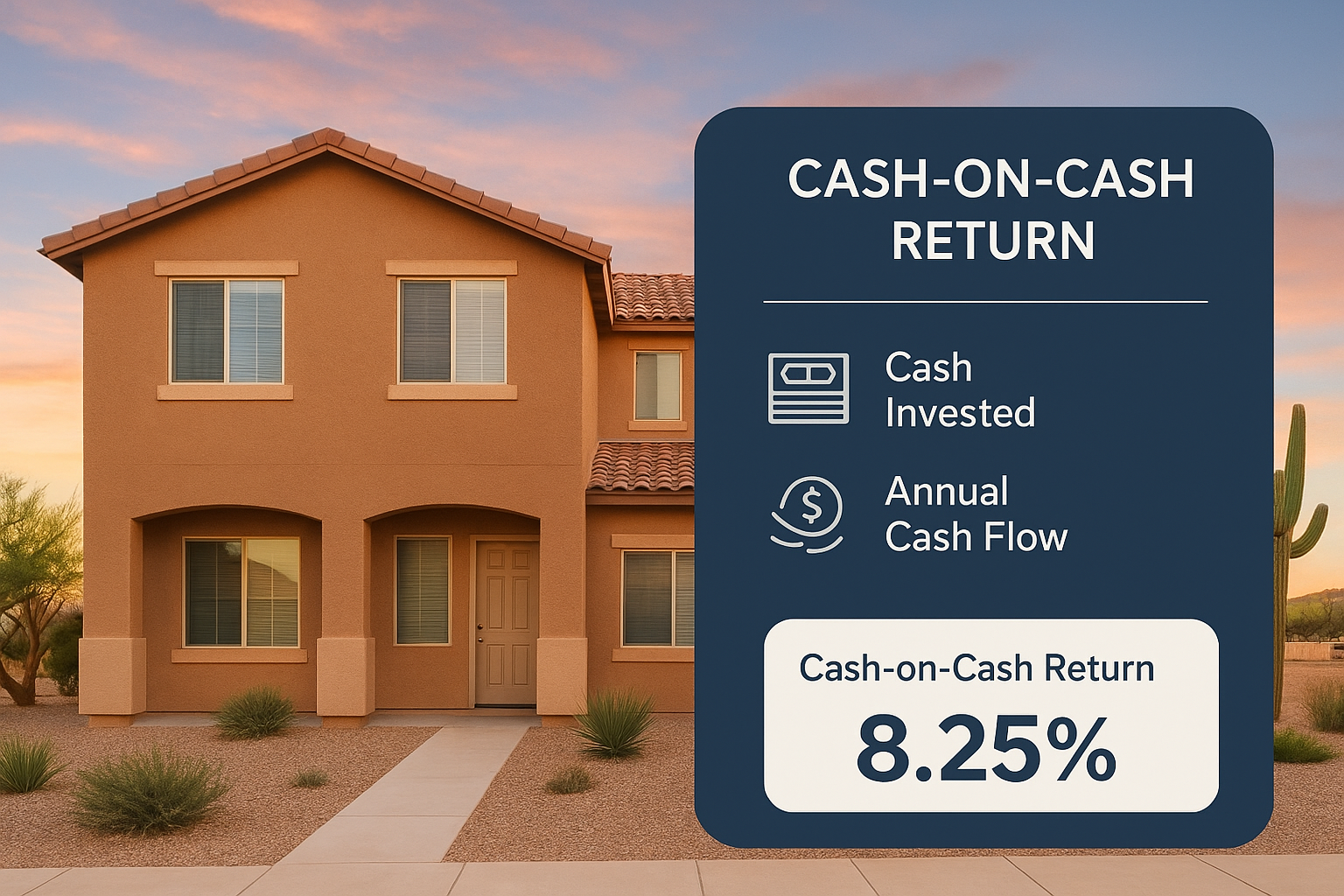
Cash-on-cash return (CoC) measures the annual cash flow you earn compared to your total cash invested into the deal.
Cash-on-Cash Return = Annual Cash Flow ÷ Total Cash Invested
Where “total cash invested” normally includes:
- Down payment
- Closing costs
- Upfront repairs or make-ready costs
- Loan fees (including DSCR points if used)
- Initial reserves (optional but recommended)
This metric matters because it identifies the true return on your actual dollars—not the bank’s.
Why Cash-on-Cash Return Matters for Arizona Investors
1. It Reflects Real Investor Performance
Financed deals (DSCR or conventional) often look mediocre on cap rate but strong on cash-on-cash due to leverage.
2. It Helps Compare Very Different Deals
With CoC, you can compare:
- a Phoenix single-family home
- a Tucson duplex
- a Glendale 4-plex
- a Maricopa new build
- a Mesa condo
CoC “equalizes” deals so you can see which one truly works harder for your money.
3. It Helps Identify Over-Leveraged or Underperforming Properties
If cash flow is negative or razor thin, cash-on-cash exposes it immediately.
4. It’s a Key Metric Lenders Look At
DSCR lenders, portfolio lenders, and private lenders all care about CoC indirectly because poor CoC often reflects operational weakness.
What Is a Good Cash-on-Cash Return in Arizona?
This varies by strategy, risk level, and timeframe, but typical ranges for 2024–2025:
- Phoenix SFR: 1–5%
- Phoenix Small Multi (2–4 units): 3–8%
- Tucson SFR/Multi: 5–10%
- Short-Term Rentals: Wide range, 0–20% (high risk/variance)
- Value-Add Projects: Varies, but CoC can grow significantly post-renovation
Remember:
Cash-on-cash return is highly influenced by financing.
Arizona Cash-on-Cash Example: Mesa Single-Family Rental
Example 1: West Phoenix Starter Rental — Low Cash Flow, Strong Cash-on-Cash
Property: 3-bed SFR in Maryvale / West Phoenix
Purchase Price: $325,000
Down Payment (20%): $65,000
Closing Costs: $6,000
Total Cash In: $71,000
Monthly Rent: $2,050
Monthly Expenses (PITI + PM + Maintenance Reserve): $2,000
Monthly Cash Flow: $50 ($600/yr)
By Cash Flow Alone
$600/yr looks “meh” — many new investors would assume this is a bad deal.
But here’s the CoC Return
CoC = $600 / $71,000
CoC = 0.85%
That seems low… until the kicker:
Where CoC Shows Hidden Value
West Phoenix has averaged 4–6% annual appreciation over the last 10 years.
Even using the conservative 3% on a $325,000 property:
Annual appreciation = $9,750
CapEx-adjusted rent growth historically averages 2–3% annually, meaning next year’s cash flow is likely:
$50 → $125 → $200 → $300/month over time
→ this is where CoC becomes meaningful. It highlights that:
- A small cash flow today does not reflect your long-term return
- Your CoC jumps dramatically as rents rise while your initial cash basis stays fixed
Why this matters for investors
This is a classic Phoenix starter rental:
mediocre cash flow day one, but historically strong total return + rent growth.
Cash-on-cash helps investors not dismiss solid long-term winners.
Example 2: Mesa Condo — Near Break-Even Cash Flow, Excellent CoC
Property: 2-bed Mesa condo near Dobson Ranch
Purchase Price: $260,000
Down Payment (25%): $65,000
Closing Costs: $5,000
Initial Repairs: $5,000
Total Cash In: $75,000
Monthly Rent: $1,825
Monthly Expenses (incl. HOA): $1,780
Monthly Cash Flow: $45 ($540/yr)
Cash Flow View
$45/month? Many people stop right there.
Cash-on-Cash View
CoC = $540 / $75,000 → 0.72%
Still modest — but…
The Important Takeaway
Condos in Mesa often have:
- Lower CapEx exposure
- Lower surprise maintenance
- High rentability (students, young professionals, ASU spillover)
- Lower vacancy
This is where CoC helps investors understand that:
A low cash flow property with low operational risk can still be a strategic winner.
The stability of returns is a huge part of the CoC story, and Mesa shines in this category.
Example 3: Tucson Fourplex — High CoC Even Without High Cash Flow
Property: 4-plex near Tucson Medical District
Purchase Price: $625,000
Down Payment (25%): $156,250
Closing Costs: $10,500
Total Cash In: $166,750
Rent per Unit: $1,100
Total Rent: $4,400
Expenses: $4,150
Monthly Cash Flow: $250 ($3,000/yr)
Cash Flow View
$250/mo is good, but not eye-popping for a fourplex.
Cash-on-Cash Return View
CoC = $3,000 / $166,750 = 1.8%
Also not huge — so why is CoC helpful here?
Where CoC Shows Investor Opportunity
Tucson multifamily regularly sees:
- Rent stability near medical + university corridors
- Low vacancy due to constant tenant pipeline
- Higher long-term resiliency vs. single-family
CoC tells beginning investors:
“Even if year-one cash flow doesn’t blow you away, stabilized multifamily offers dependable long-term returns.”
The upside is in stability, turnover control, and appreciation — not massive cash flow day one.
Summary of Arizona CoC Examples
These examples highlight why cash flow alone often paints an incomplete picture.
Arizona markets — Phoenix, Mesa, Tucson — frequently deliver:
- modest year-one cash flow,
- but strong long-term total return,
- offset by rent growth,
- in markets with stable job, population, and demand trends.
Cash-on-cash return helps beginning investors understand that a deal with small cash flow today can be an excellent long-term performer.
As an investor metric, cash-on-cash is especially useful for:
- value-add purchases
- BRRRR projects
- DSCR-financed STRs
- older homes with strong rent upside
- small multis in Tucson or Glendale
- any deal where financing terms matter
Cash-on-Cash vs. Cap Rate (Know the Difference)
Cap rate measures property performance without financing.
Cash-on-cash measures investor performance with financing.
A deal can have:
- Strong cap rate but weak cash-on-cash (common with expensive renovations)
- Weak cap rate but strong cash-on-cash (common with optimal DSCR financing)
Both metrics matter—but for financed buyers, cash-on-cash tells the truth.
How To Improve Cash-on-Cash Return (Arizona Strategies)
1. Improve Financing Structure
DSCR IO, 40-year amortization, or buying down the rate can transform marginal cash flow.
2. Add Value
Upgrades that justify higher rents can push CoC positive.
3. Buy Small Multis Instead of SFRs
2–4 units often outperform Phoenix SFRs by 3–7% CoC.
4. Target Stronger Price-to-Rent Markets
e.g. Mesa ≫ Scottsdale for cash flow.
5. Avoid High-HOA Communities
They destroy margin.
6. Avoid Over-Renovating
Every dollar you add to your total cash invested reduces CoC unless rents increase proportionally.
How DTD Realty Helps You Maximize CoC
We can help you run full investor analysis including:
- Cash-on-cash modeling
- DSCR pre-underwriting
- Scenario-based financing strategies
- 10-year cash flow projections
- Renovation ROI evaluation
- Deep rent comp analysis
- Zip-by-zip yield mapping throughout Arizona
Your return is not a guess—it’s a model we help you build with precision.
DTD Realty — Do The Deal.
Driven. Trusted. Dependable.
📞 602.702.3601
🌐 https://www.dtdrealty.com
📩 [email protected]