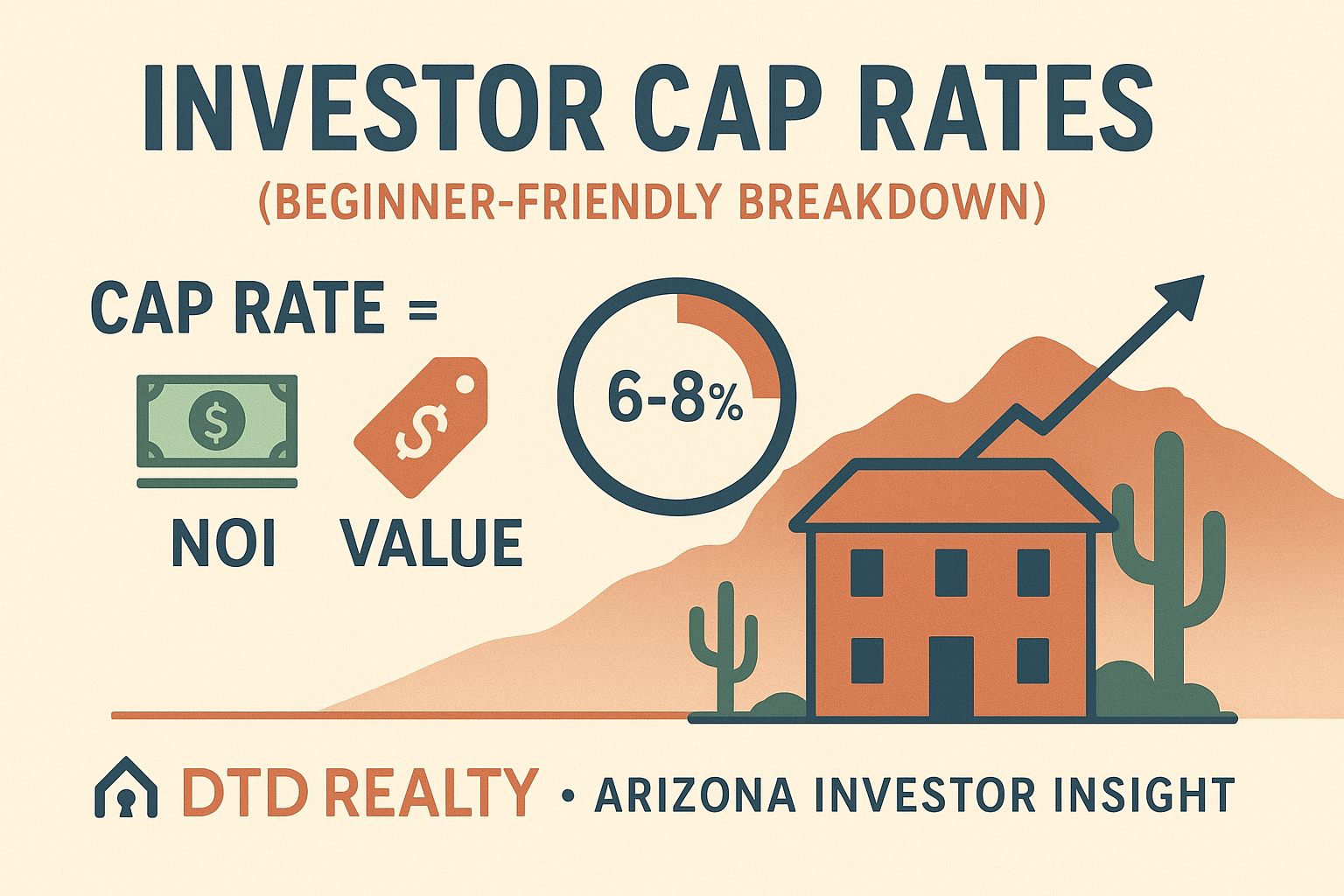
If you’re getting started in real estate investing, you’ve probably heard the term cap rate thrown around a lot. It’s one of the simplest—but most misunderstood—metrics in the industry.
And for Arizona investors, understanding cap rates can help you quickly compare rentals in Phoenix, Mesa, Tucson, and fast-growing areas like Queen Creek, Buckeye, and Maricopa.
This guide breaks cap rates down in a clean, practical way—zero jargon, beginner friendly.
What Is a Cap Rate? (Simple Definition)
A cap rate—short for capitalization rate—is a quick snapshot of an investment property’s expected return if you bought it in all cash.
It is calculated with one formula:
Cap Rate = Net Operating Income (NOI) ÷ Purchase Price
Where NOI =
Gross Rents – Operating Expenses (taxes, insurance, maintenance, management, utilities you pay, HOA, etc.)
Does NOT include mortgage payments.
Cap rate is basically:
“How hard is this property working for me if I paid cash?”
Why Cap Rate Matters for Arizona Investors
1. Fast Comparison Between Properties
Cap rate helps you compare:
- a rental in Phoenix vs. one in Tucson
- a Tempe condo vs. a Buckeye single-family house
- an older home in Glendale vs. a new build in Maricopa
It levels the playing field.
2. Helps Identify Overpriced or Underperforming Properties
If a property has a very low cap rate compared to the local average, something is off:
- rents too low
- taxes/insurance too high
- or the price is inflated
3. Helps Project Future Returns
Cap rate isn’t the whole story, but it’s a great starting point before diving deeper into cash flow, appreciation, tax benefits, long-term hold strategy, and Arizona-specific trends.
Typical Cap Rates in Arizona (2025 Ranges)
These are general ranges—not rules. Neighborhoods, property type, age, and condition matter.
Phoenix Metro (SFR Rentals):
- 4–6% cap rate is common
- Newer builds often closer to 4%
- Older homes closer to 6%
Tucson Metro:
- 5–7% common
- Some duplexes/fourplexes stretch higher
Flagstaff & Sedona Area:
- 3–5% typical due to high prices
- Lower cap rates, higher appreciation plays
Small-Multi (Duplex–Fourplex) in Phoenix & Glendale:
5–7% depending on rents, condition, and era
Commercial / NNN:
5–7% depending on tenant and lease structure
Cap rates are only a snapshot, but they help beginners understand whether a deal falls in a normal Arizona range.
What Cap Rate Does Not Tell You
A big mistake beginners make is thinking cap rate tells the whole story.
It doesn’t.
Cap rate does NOT show:
- Cash flow after financing
- Appreciation potential
- Tax benefits (depreciation)
- Rental demand strength
- Vacancy trends
- Renovation costs
- Long-term rent growth
- HOA restrictions or STR/long-term limits
This is why in DTD Realty’s investor analysis, cap rate is only one metric, not the decision-maker.
Cap Rate Example: Arizona Single-Family Rental
Let’s say you’re analyzing a home in Surprise, AZ.
Gross Annual Rent:
$2,200/month = $26,400/year
Operating Expenses:
- Taxes: $1,900
- Insurance: $1,300
- Management: $2,112
- Maintenance Reserve: $1,500
- HOA: $600
- Other misc: $500
Total Expenses: $7,912
NOI:
$26,400 – $7,912 = $18,488
Purchase Price:
$380,000
Cap Rate:
$18,488 ÷ $380,000 = 4.86%
This falls right in line with Phoenix-area expectations.
Cap Rate vs. Cash-on-Cash Return (Don’t Confuse Them)
Cap rate = assumes all-cash purchase
Cash-on-cash return = includes your loan, down payment, and financing costs
Two different metrics with two very different purposes.
Arizona investors who use financing typically rely on:
- cash-on-cash return
- DSCR
- 10-year cash flow projections
- exit strategy ROI
Cap rate is the starting point—not the final decision.
When Higher Cap Rates Are Not Better
A high cap rate can signal:
- weaker neighborhoods
- older systems
- higher crime pockets
- slower rent growth
- higher turnover
- higher repair and capital expense risk
A “too good to be true” cap rate often comes with hidden headaches.
What’s a Good Cap Rate in Arizona?
There is no universal “good.”
Instead ask:
Does the cap rate match the risk, market, and my long-term strategy?
In general:
- Low cap rate = stronger appreciation, better neighborhoods
- High cap rate = more cash flow, more risk
Your goals determine which is better.
If you want help building a balanced Arizona portfolio with both appreciation and cash flow plays, that’s exactly what we do at DTD Realty.
DTD Realty — Do The Deal.
Driven. Trusted. Dependable.
📞 602.702.3601
🌐 https://www.dtdrealty.com
📩 [email protected]