If you invest from out of state, Phoenix has probably been on — or near — the top of your radar for years. But after the rapid run-ups, the interest-rate roller coasters, and the wave of new multifamily construction, many investors are asking the same question:
“Is Phoenix still a good rental market in 2026… or did I miss the window?”
Let’s cut through the hype and take an honest, data-backed look at what’s real, what’s noise, and where the smart money is moving.
The Big Picture: Phoenix in 2026 Is No Longer a Pure Appreciation Play — But It’s Still a Growth Market
Phoenix is not the 2016–2021 rocket ship.
It’s a mature growth market now — still expanding, still outperforming national averages, but requiring sharper underwriting and more strategic property selection.
3 Things That Still Make Phoenix Strong in 2026
✔ Population Growth is Slowing — but Still Positive
Domestic in-migration remains solid, especially from California, Illinois, and Washington. Slower doesn’t mean stopped — the metro is still adding tens of thousands of people per year.
✔ Job Growth Remains Nationally Competitive
2024–2025 saw a cooling, but 2026 projections show renewed demand in:
- Healthcare
- Logistics
- Semiconductor manufacturing (Intel + TSMC ripple effects)
- Professional services
- Construction tied to industrial expansion
✔ Long-Term Housing Undersupply Still Exists
Despite more inventory than recent years, Phoenix remains structurally undersupplied — especially for affordable starter homes and mid-tier rentals.
Translation for investors:
The Phoenix rental market in 2026 is still healthy, but the easy money phase is gone. You need strategy now, not luck.
Rental Rates in 2026: Stabilizing, Not Falling — But Highly Neighborhood-Dependent
After a cooling period between 2023–2024, rent growth turned mildly positive in 2025, and 2026 is projected to continue a slow upward trend.
Where Rent Growth Is Strongest
- Buckeye
- Laveen
- Glendale West
- Surprise
- Queen Creek / San Tan Valley
These areas benefit from affordability, strong population inflow, and new households priced out of central Phoenix or Scottsdale.
Where Rents Are Flat or Soft
- Downtown Phoenix (oversupply of Class A apartments)
- Tempe (student supply spike)
- Chandler (inventory absorption from 2023–2024 builds)
Translation:
The Phoenix rental market in 2026 is not a rising tide lifting all boats.
Your zip code matters more than ever.
Cash Flow in 2026: Possible — but Not Everywhere, and Not Without Strategy
Let’s be honest:
Most turnkey neighborhoods with “safe” reputations no longer cash flow at 30% down.
But the opportunities are still there — especially through creative strategies:
Cash-Flow Opportunities in 2026
- Value-add entry points in West Phoenix and South Phoenix
- Medium-term rentals (travel nurses, medical staff, consultants)
- Properties with ADUs or room to add one
- Small multifamily (2–4 units) in older neighborhoods
- House hacking in appreciating suburbs
- BRRR opportunities in fringe growth corridors
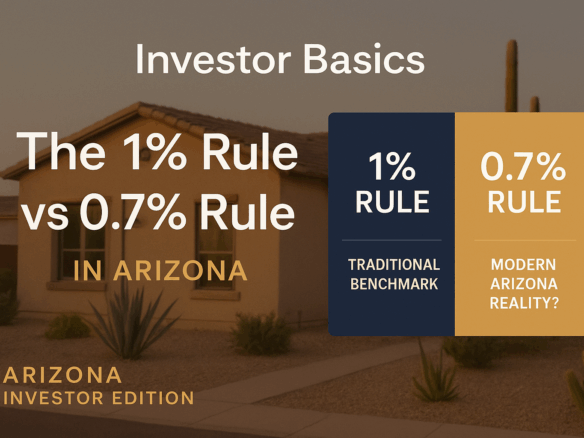
Phoenix isn’t the 1%-rule paradise… but it is a place where value creation can outperform other metros.
The 2026 Investor Shift: From Scottsdale and Arcadia to the Suburban Growth Belt
Investors coming in from out of state often think:
“Scottsdale = best investment.”
But seasoned investors know: appreciation markets ≠ rental markets.
Where Smart Investors Are Moving in 2026
For cash flow:
- Maryvale
- South Phoenix (85041, 85042)
- West Phoenix
- North Glendale
- Mesa west of Dobson
- Tempe north of the 60
For appreciation + stability:
- Gilbert
- Chandler (careful underwriting)
- Peoria
- Surprise
- Goodyear
For long-term growth bets:
- Buckeye (massive future employment hubs)
- Queen Creek & San Tan Valley
- Laveen (new freeway access = rising demand)
Risks Investors Need to Understand in 2026
Phoenix is strong — but not risk-free.
A brutally honest analysis requires addressing the real concerns:
Risk 1: Inventory Surges in Certain Submarkets
Class A apartments continue to deliver downtown and in some East Valley pockets.
Risk 2: Insurance Costs Are Up Across the Southwest
Not Florida levels… but still an underwriting factor.
Risk 3: Uneven Rent Growth
Selecting the wrong zip code in 2026 could mean flat rents for 12+ months.
Risk 4: Increased Local Competition
More small investors know about Phoenix now.
But fewer out-of-state investors are entering compared to 2020–2022, which actually helps balance the market.
So… Is Phoenix Still a Good Rental Market in 2026?
Short answer:
✔ Yes — if you choose the right submarkets and invest with strategy.
✘ No — if you expect 2020-style appreciation or cash flow without value-add.
Phoenix remains one of the strongest long-term rental markets in the U.S.
Not because it’s the cheapest…
Not because it’s the fastest growing…
But because it’s structurally healthy, economically diversified, and driven by long-term population fundamentals.
Smart investors will keep buying here in 2026.
They’ll just buy different types of deals than they bought in 2020.
DTD Realty — Do The Deal.
Driven. Trusted. Dependable.
📞 602.702.3601
🌐 https://www.dtdrealty.com
📩 [email protected]